
Ladakh: The Complete Guide for Discerning Travellers

Updated: Jun 16
I N T R O D U C T I O N
Most People Who Visit Ladakh See About a Third of It
Leh. Nubra. Pangong. Those three names account for ninety percent of every Ladakh trip ever booked and they account for perhaps thirty percent of what the region actually is.

I don't say this to be contrarian. I say it because Ladakh is genuinely one of the most extraordinary places in the world, and the version most travellers return home having experienced is, frankly, the introductory chapter. The sand dunes, the double-humped camels, the lake photograph at sunrise these are real and worth seeing. But they are not the point.
The point is the Changthang plateau at dusk when the last light catches Tso Moriri and there is no one else within thirty kilometres. The point is a January night at Hanle when the Milky Way is so dense it looks like cloud cover until your eyes adjust. The point is watching a snow leopard move across a ridge-line in Hemis and understanding, without needing anyone to tell you, that you are somewhere very few people ever get to be.
This guide is written for the traveller who wants that version of Ladakh. It is not for everyone and I mean that as useful information, not a provocation. Ladakh asks something of you. It asks for time, for patience, for a willingness to let altitude dictate your pace. It rewards those things extraordinarily well. It does not reward being rushed through it in five days with back-to-back drives and a highlight reel to show for it.
Whether you are planning your first Ladakh trip or returning to go deeper, this is everything you need to approach it properly.
U N D E R S T A N D I N G L A D A K H
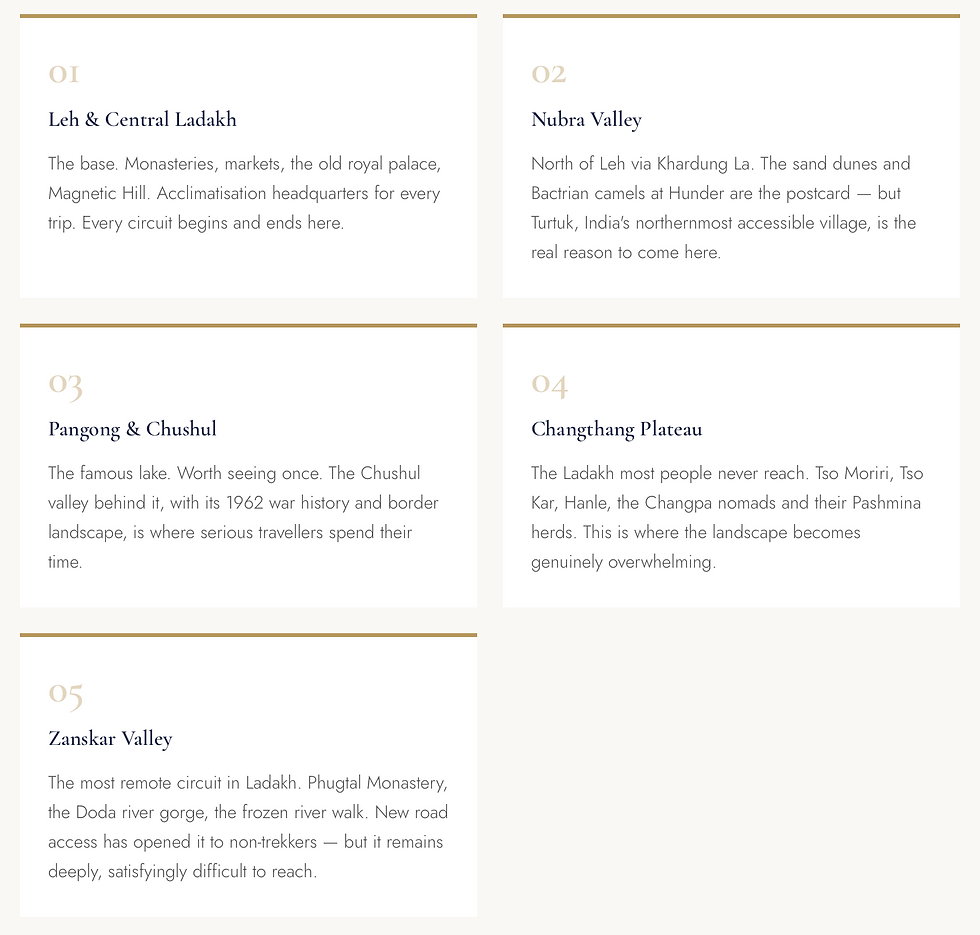
Ladakh Is Not One Place — It Is Five Completely Different Worlds

One of the most common mistakes in Ladakh planning is treating it as a single destination with a list of sights to tick off. The region spans roughly 59,000 square kilometres larger than many countries and its circuits are geographically, culturally, and experientially distinct from each other. Understanding this before you plan changes everything.
G J F I E L D I N T E L L I G E N C E
Most first-time Ladakh trips cover circuits 1 through 3. Most people who come back a second time are chasing circuits 4 and 5. Understanding which circuit you are planning for and building your itinerary around that honestly is the single most important planning decision you will make.
W H E N T O G O
When to Visit Ladakh — Matched to What You Are Actually Looking For

The standard answer to "when should I visit Ladakh" is July to September. That is correct for the traveller who wants maximum accessibility, all roads open, and mild daytime temperatures. It is also the answer that puts you in Ladakh alongside the largest volume of tourists the region sees all year.
The more useful answer starts with what you want from the trip.

October and November deserve special mention. The tourist season has ended, the camps are still open, the roads are clear, and the skies above the Changthang plateau are some of the clearest on earth. For the discerning traveller who wants Ladakh without the crowd noise — this is the window. Most people don't know it exists.
W H O I T I S F O R
Is Ladakh the Right Trip for You? Honest Answers for Different Travellers

Most travel writing about Ladakh either sells it to everyone or warns everyone off. Neither is useful. Here is the honest picture for the travellers we work with most.


T H E A L T I T U D E R E A L I T Y
Altitude in Ladakh: The One Variable That Determines Everything

Leh sits at 3,500 metres above sea level. That is higher than most peaks in the Alps that attract crowds of altitude-conscious mountaineers. The surrounding circuits range from 3,800m in Nubra Valley to over 5,400m at Umling La. These are not numbers to be footnoted they are the single most important planning consideration in a Ladakh trip.
Altitude sickness at this level is not a sign of weakness or poor physical fitness. It is a physiological response that affects competitive athletes as readily as sedentary travellers. The oxygen concentration at 3,500m is roughly 65% of what it is at sea level. Your body needs time typically 36 to 48 hours at minimum to begin producing additional red blood cells and adjust haemoglobin levels. That adjustment cannot be rushed, and no amount of fitness preparation substitutes for it.
The most common mistake in Ladakh itineraries is treating acclimatisation as a delay rather than a design principle. A well-built Ladakh trip gives you two full days in Leh before any significant altitude gain days spent walking slowly, eating lightly, hydrating aggressively, and sleeping early. Not days spent driving to monasteries and viewpoints as though the trip has already begun at full pace.
G J F I E L D I N T E L L I G E N C E
We sequence every Ladakh itinerary with altitude logic built in from day one. That means Leh and Sham Valley first, Nubra and Pangong at mid-trip, Changthang at its highest elevation only when the body has had time to adjust. Operators who ignore this sequencing are optimising for activity count, not for the quality of your experience or your health.
A few practical notes that matter: Diamox (acetazolamide) is commonly recommended by travel medicine specialists for altitude prevention consult your doctor before travel. Garlic soup, widely sold in Leh restaurants, has genuine local reputation as an acclimatisation aid. Alcohol at altitude has an amplified effect and is worth avoiding for the first two days entirely. And oxygen cylinders, while available at good hotels and in well-equipped vehicles, are a contingency measure not a substitute for acclimatisation time.
W H A T T O E X P E R I E N C E
Six Ladakh Experiences That Justify the Distance
Not sights to see. Experiences to have and the distinction matters more here than almost anywhere else. Ladakh has few monuments that demand your presence. It has landscapes, encounters, and moments that restructure how you think about travel entirely.
A Night at Hanle Under a Bortle Class 1 Sky

The Hanle Dark Sky Reserve, at approximately 4,500 metres in the Changthang plateau, has 270-plus clear nights a year, negligible light pollution from any direction, and high-altitude dry air that removes the atmospheric scattering that dulls night skies everywhere else. When Hanle is clear, the Milky Way is not a faint stripe across the horizon it is the dominant feature of the sky, dense and architectural. The Indian Astronomical Observatory sits here for precisely these reasons. A night at Hanle is one of the most singular experiences available anywhere in India.
Snow Leopard Tracking in January

Hemis High Altitude National Park in winter. The snow drives the blue sheep the snow leopard's primary prey down from the high ridges into accessible valleys, and the leopards follow. January and February sighting rates at Hemis are among the highest of any snow leopard habitat on earth. This is not a guaranteed experience nothing in wildlife is but it is, with the right guide and the right positioning, an experience of genuine and extraordinary probability.
Private Access at a Working Monastery

Thiksey at dawn, before the first tourist vehicle arrives, when the morning puja is underway and the horns carry across the valley this is not the same place you encounter two hours later with three busloads of visitors. Timing and relationships with the monastic communities make the difference between a cultural visit and a cultural encounter. We build the first kind into our itineraries.
The Changthang Plateau Without a Schedule

The part of Ladakh planning that most itineraries get most wrong is the Changthang. It is not a drive-through. The plateau vast, high, almost impossibly quiet is a place that reveals itself slowly. The Changpa nomads moving their herds across the horizon. The absolute clarity of the air. The sense that nothing between you and the landscape is mediated. This requires a day or two with no fixed agenda, and that day is almost always the one guests remember longest.
Meeting the Changpa

The Changpa are the nomadic herders of the Changthang plateau the people who have bred Pashmina goats at altitude for centuries. The Pashmina in your wardrobe, if it is genuine, traces back to them. Sitting with a Changpa family in their rebo tent, drinking butter tea, understanding the migration logic of their year this is the kind of encounter that no package tour includes and no amount of research replaces.
Turtuk, at the Northern Edge of India

India's northernmost accessible village was part of Pakistan until 1971. Turtuk is Balti ethnically, linguistically, architecturally and it wears its unique identity with quiet dignity. The apricot orchards in summer, the Shyok river below, the old royal house, the memory of a border that moved living people across it: Turtuk is one of the most historically loaded places in India and one of the least visited. Getting here properly adds a day to your Nubra itinerary. It is worth every kilometre.
W I L D L I F E
The Animals That Make Ladakh Extraordinary
Ladakh is not conventionally thought of as a wildlife destination and that is part of what makes its wildlife so compelling. The species that inhabit this high-altitude cold desert have adapted to conditions that would be lethal to most of their relatives elsewhere, and encountering them here, in this landscape, carries a weight that a conventional safari does not.

The kiang — the Tibetan wild ass roams the Changthang plateau in herds of several dozen. There is something almost prehistoric about watching them run; they are the largest wild equid in the world and they move across the plateau with an ease that makes the altitude look effortless. You will almost certainly see them if you go to Changthang. You will not forget them.
The snow leopard is the headline rightfully so. Fewer than 500 are estimated to live in the entire Indian Himalaya, and Hemis National Park holds one of the highest densities of any protected area on earth. Winter is the window. The guides who work this terrain know their individual leopards by territory and behaviour. A sighting, when it comes, is not casual. It stays with you for years.

The black-necked crane winters at Tso Moriri and Tso Kar — two of only a handful of sites in India where this endangered Tibetan crane can be reliably found. Graceful, enormous, and entirely incongruous in a landscape this stark, a black-necked crane sighting at a high-altitude lake at dawn is the kind of moment that recalibrates what you expect from a trip.

Beyond these three, Ladakh holds Himalayan blue sheep (bharal), red fox, Tibetan wolf, woolly hare, bearded vulture (Lammergeier), golden eagle, and in the rivers and streams the rare snow trout. Birdwatchers with serious intent will find Ladakh enormously productive from May through September.
W H E R E T O S T A Y
Where to Stay in Ladakh: What the Brochures Don't Tell You
Ladakh requires a recalibration of what luxury means. This is not a destination where a five-star brand name translates reliably into a five-star experience altitude, remoteness, and the fundamental limitations of infrastructure in a high-cold-desert mean that the best stay in Pangong is not comparable to the best stay in Mumbai or Udaipur. Understanding and accepting this before you arrive is part of travelling Ladakh well.

In Leh, a handful of properties deliver genuine comfort and considered hospitality proper heating systems, reliable hot water, attentive service, and in-house knowledge about the region. The Grand Dragon Ladakh and The Chamba Camp Thiksey are two that consistently perform. Neither is flashy. Both get the fundamentals right, which matters enormously at 3,500 metres.
In Nubra, the camp landscape has improved significantly. The Himalayan Glamping camps at Hunder offer well-insulated tents and better-than-expected food. The key selection criterion is not design it is gate proximity and in-house guide quality. A beautiful camp an hour from your entry point costs you two hours of driving per day that would be better spent in the landscape.

At Pangong, most camps are honest about what they are basic structures at the edge of a spectacular lake. The lake does most of the work. Of the options available, The Pangong Retreat and Apricot Tree camps deliver the most reliable combination of location and service. Manage your expectations for the room itself; don't manage them for the morning view from outside it.

At Tso Moriri, infrastructure is genuinely limited. The Korzok Retreat, operated with care and considerable ingenuity given where it sits, is the standard-bearer. Being there at 4,522 metres, on a lake that sees a fraction of Pangong's visitors compensates completely for whatever the room lacks.
At Hanle, honest luxury does not yet exist in the conventional sense. What exists is a small set of well-maintained guesthouses and the extraordinary compensation of being at one of the darkest sky sites on earth. The experience is the accommodation. Plan accordingly.
G J F I E L D I N T E L L I G E N C E
We select properties in Ladakh based on two questions above all others: how close is this lodge to the entry point or landscape it is meant to serve, and does the team running it understand the terrain they are sitting in. A naturalist-led camp with basic tents beats a design-forward property whose staff have never been into the landscape around them. Every time.
F R E Q U E N T L Y A S K E D
Your Ladakh Questions, Answered Honestly
These are the questions we receive most often from travellers in the planning stage from first-timers to those returning for a more considered journey.
What is the best time to visit Ladakh?
The most popular window is July to September when all roads are open and the landscape is at its most accessible. October and November are arguably better for discerning travellers skies are clearer, crowds have gone, and Hanle is at its best for stargazing. January to February is prime for snow leopard tracking in Hemis National Park. Each season offers a genuinely different Ladakh
Is Ladakh safe for senior travellers or those above 60?
Yes, with the right planning. The key variable is altitude Leh sits at 3,500m and surrounding circuits range higher. A mandatory two-day acclimatisation in Leh, circuit sequencing that respects altitude gain, and an operator who builds these into the itinerary design makes Ladakh entirely achievable for most 60+ travellers in reasonable health. The Sham Valley circuit, which stays below 3,500m, is often the ideal anchor for this profile.
What is the Changthang Plateau and why is it worth visiting?
Changthang is Ladakh's high-altitude plateau in the east home to Tso Moriri, Tso Kar, Hanle and the Chushul valley. Most Ladakh tourists never reach it. It is where the Changpa nomads graze their Pashmina herds, where the night skies are among the darkest on earth, and where the landscape strips away any noise between you and the terrain. For many travellers, it is the part of Ladakh that makes everything else feel like a warm-up.
Can you visit Ladakh in winter?
Yes. Winter Ladakh January to February is extraordinary for the right traveller. Snow leopard tracking in Hemis High Altitude National Park reaches its peak, the landscape is completely transformed, and there are almost no other tourists. Several lodges remain open. It demands more preparation and a tolerance for extreme cold, but the experience is unlike any other season.
How many days should I plan for a proper Ladakh trip?
A minimum of 8 nights for a meaningful experience. Less than that and you spend half the trip acclimatising. Ten to twelve nights allows you to cover Leh and Central Ladakh, one or two outer circuits, and have at least one unhurried day in the landscape. Ladakh punishes rushed itineraries more than most destinations.
What permits do Indian travellers need for Ladakh?
Indian travellers do not require an Inner Line Permit for most of Ladakh. However, certain areas including Hanle, the Changthang Wildlife Sanctuary, and zones near the Line of Actual Control require Protected Area Permits or environmental fees. Hanle now has a daily visitor cap and advance permits must be arranged. Foreign nationals require permits for most areas beyond Leh. A good operator handles all of this without you needing to manage it.
Is Ladakh worth visiting if you have already been once?
Entirely. Most first trips cover Leh, Nubra and Pangong roughly a third of what Ladakh actually offers. Changthang, Zanskar, Turtuk, winter Ladakh, and Hanle are each complete travel experiences in their own right. The Ladakh that most people have seen and the Ladakh that waits beyond it are genuinely different places.
What is the Hanle Dark Sky Reserve?
Hanle, in the Changthang plateau at approximately 4,500m, is home to India's first dark sky reserve. With 270-plus clear nights a year, negligible light pollution, and high-altitude dry air, it offers some of the best stargazing conditions in Asia. The Indian Astronomical Observatory is located here. A night at Hanle under a Bortle Class 1 or 2 sky is one of the most extraordinary experiences available in India.
G O D E E P E R
Our Ladakh Guides
Each article below is built around a specific dimension of Ladakh — written from field experience and structured for the traveller planning a serious trip.
P L A N Y O U R J O U R N E Y
Ladakh designed well is one of the great travel experiences in the world. Designed poorly, it is an expensive, uncomfortable, rushed introduction to a place that deserved more of your time. At Global Journeys, we build Ladakh itineraries around the traveller first — their age, their pace, their version of extraordinary. If you are planning a Ladakh trip and want it done properly, start the conversation with us. Whatsapp +91 8879170009

Comments