
When to Visit Ladakh: A Season-by-Experience Guide

I N T R O D U C T I O N
"Best Time to Visit Ladakh" Is the Wrong Question
Every Ladakh guide answers this the same way: July to September. It's not wrong. It's just answering a question you probably haven't actually asked yet.

July to September is when all of Ladakh's roads are open, when the weather is at its mildest, and when the landscape looks the way it does in almost every photograph you've seen of the region. It is also, for exactly those reasons, when Ladakh sees the overwhelming majority of its annual visitors which means queues at popular viewpoints, fully booked camps at Pangong, and a version of the region that, while beautiful, is rarely quiet.
The more useful question is: what do you actually want from Ladakh? Because depending on the answer, the "best" time to go might be October, or January, or a specific ten-day window built around a lunar calendar. This guide works backwards from experience to season so you can match your trip to the Ladakh that actually suits what you're looking for.
T H E F R A M E W O R K
Match the Season to What You Want, Not the Other Way Around
Before the month-by-month breakdown, here's the high-level logic. Ladakh offers genuinely different not just marginally different experiences depending on when you go. These aren't variations on a theme. They are, in several cases, completely different trips that happen to take place in the same geography.

M O N T H B Y M O N T H
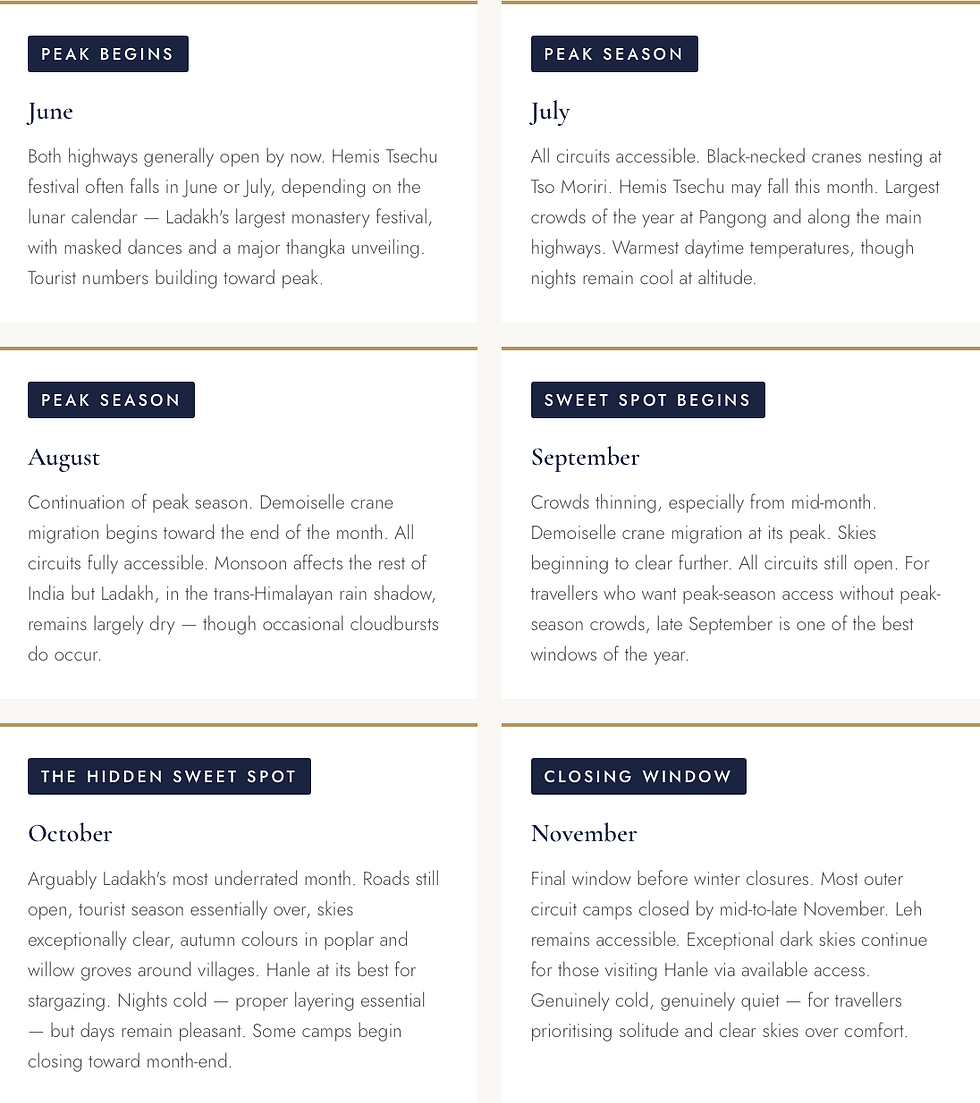
Ladakh Through the Year

A closer look at what each part of the year actually offers including the months most itineraries skip entirely.

F E S T I V A L S
The Ladakh Festival Calendar
Ladakh's monastery festivals follow the Tibetan lunar calendar, which means dates shift from year to year and need to be confirmed for the specific year you're travelling. They are not, however, something to build an entire trip around in isolation the strongest approach is to treat a festival as a highlight within a broader itinerary, not the itinerary itself.

Hemis Tsechu
The largest and most significant of Ladakh's monastery festivals, held at Hemis Monastery, typically in June or July depending on the lunar calendar. Marked by masked dances (cham) performed by monks depicting the triumph of good over evil, and once every twelve years the unveiling of a monumental thangka. Even in non-unveiling years, the festival draws visitors from across the region and offers an immersive look at living Buddhist practice.
Losar
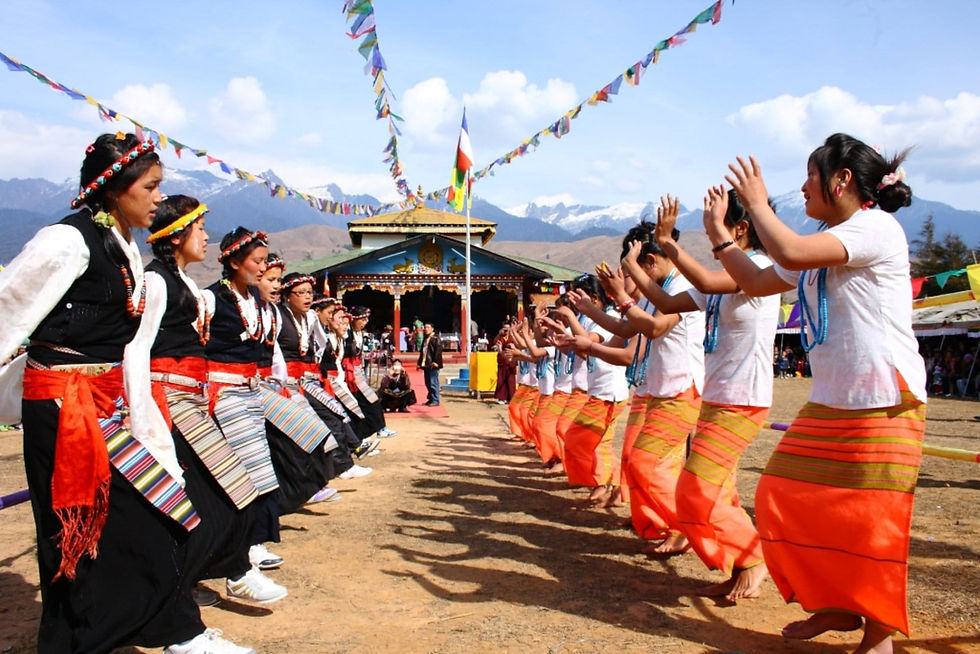
The Tibetan New Year, observed with prayers, feasting, and ceremonies at monasteries and homes across Ladakh. Depending on which calendar tradition is followed, Losar can fall in December or February. It is a quieter, more community-oriented festival than Hemis Tsechu, and for travellers in Ladakh during winter for snow leopard tracking, an unexpected cultural dimension to an otherwise wildlife-focused trip.

Smaller Monastery Festivals
Throughout winter and spring, smaller festivals such as Matho Nagrang (at Matho Monastery, featuring the dramatic "oracle" ceremonies) and Dosmoche (the "scapegoat" festival, performed at several monasteries) offer more intimate, less-visited windows into Ladakh's monastic calendar. These require local knowledge to time correctly and are rarely part of standard itineraries which is precisely their appeal for travellers seeking something genuinely different.
G J F I E L D I N T E L L I G E N C E
Festival dates need to be confirmed for the specific year they are not fixed on the Gregorian calendar and can shift by weeks. We check confirmed dates before building any itinerary around a festival, and we'd always recommend treating the festival as one extraordinary day within a longer trip, not the reason for the entire trip's timing.
O U R R E C O M M E N D A T I O N
The Case for October and November
If we had to point to a single window that most consistently surprises the travellers we work with in a good way it would be October, and to a lesser extent early November.
By October, the roads remain open, but the volume of traffic on them has dropped dramatically. Camps that were fully booked in August have availability. Viewpoints that required patience for an unobstructed photograph in July are empty. The light always one of Ladakh's defining qualities takes on a particular clarity in autumn, with longer shadows and a quality that photographers consistently describe as some of the best of the year.
For stargazing specifically, October and early November represent Hanle at close to its best: the brutal extremes of deep winter haven't arrived, multi-hour night sessions are demanding but achievable, and the sky conditions are exceptional. Combined with the autumn colours appearing in the poplar and willow groves around villages across Ladakh a detail almost entirely absent from typical Ladakh photography October offers a version of the region that looks genuinely different from the images most people associate with it.

F R E Q U E N T L Y A S K E D
When to Visit Ladakh: Your Questions Answered
What is the best month to visit Ladakh?
There is no single best month — it depends on what you want. July to September offers full road access and classic landscapes but the largest crowds. October and November offer clear skies, dramatic light and almost no tourists, ideal for stargazing and photography. January and February are best for snow leopard tracking. For most first-time travellers seeking a balance of access and fewer crowds, late September is an excellent choice.
Is October a good time to visit Ladakh?
October is one of the best and most underrated months to visit Ladakh. Roads remain open, the tourist season has ended, skies are exceptionally clear, autumn colours appear in the poplar and willow groves around villages, and the Hanle Dark Sky Reserve offers some of its best conditions of the year. Temperatures drop noticeably, especially at night, so warm layering is essential.
Can you visit Ladakh in winter and is it worth it?
Yes, and for the right traveller, winter Ladakh between December and February is one of the most rewarding times to visit. It offers the best snow leopard tracking conditions in Hemis National Park, a completely transformed snow-covered landscape, and virtually no other tourists. It requires significant cold-weather preparation, as temperatures regularly fall to -15°C to -20°C or lower, and some roads and properties are closed.
When do the roads to Ladakh open and close?
The Srinagar-Leh and Manali-Leh highways typically open between late May and June, depending on snow clearance, and remain open until around October or early November. Leh itself is accessible year-round by air. High passes leading to outer circuits such as Changthang and Nubra generally follow similar seasonal patterns, though some routes may open or close at slightly different times depending on conditions.
What is the Ladakh festival calendar?
The most significant Ladakh festivals include Hemis Tsechu, held in June or July at Hemis Monastery, featuring masked dances and a major thangka unveiling; Losar, the Tibetan New Year, typically falling in December or February depending on the calendar followed; and smaller monastery festivals such as Matho Nagrang and Dosmoche through winter and spring. Dates shift annually as they follow the Tibetan lunar calendar.
C O N T I N U E R E A D I N G
More from Our Ladakh Series
P L A N Y O U R J O U R N E Y
The right time to visit Ladakh is the time that matches what you're hoping to experience and getting that match right is one of the most important decisions in planning the trip. At Global Journeys, we start every Ladakh conversation with exactly this question. If you're working out when to go, we'd be glad to help you think it through. Whatsapp +91 8879170009


Comments