
Japan Bullet Train Guide — JR Pass, Seat Reservations & Shinkansen Tips

Updated: May 19
JR Pass or individual tickets? Reserved or unreserved? Nozomi or Hikari? This is the only guide you need for Japan's bullet train — including how to actually book it.

KM/H TOP SPEED | TOKYO → OSAKA | FATAL ACCIDENTS SINCE 1964 | ON-TIME ARRIVAL RATE |
320 | 2:27 | 0 | 99.9% |

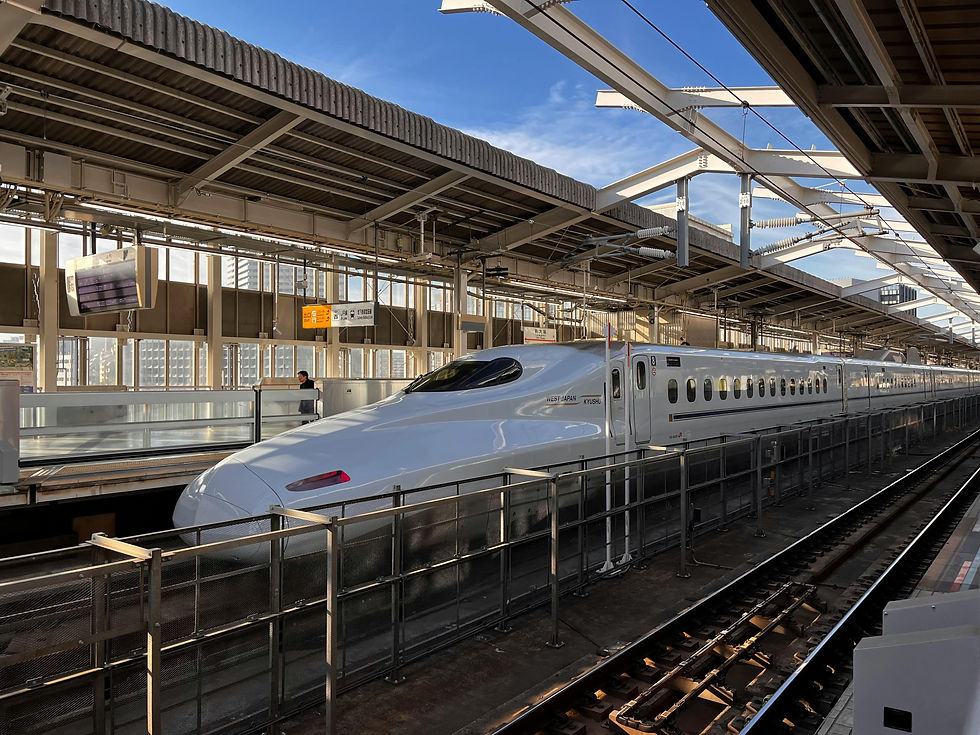
Since 1964, when the Tokaido Shinkansen launched for the Tokyo Olympics, Japan has operated this network without a single passenger fatality due to derailment or collision. The average delay is 36 seconds. That is the statistic you tell people when they cannot quite believe it.
The ticketing system, however, is genuinely confusing for first-time visitors multiple pass types, reserved versus unreserved seats, train categories with different stopping patterns, and pricing that changes based on whether you're using a JR Pass or buying individual tickets. This guide untangles all of it.



Regional JR Passes — Often Better Value
If your itinerary is geographically concentrated, regional passes often outperform the national pass significantly. The Kansai Area Pass covers unlimited JR travel in Osaka, Kyoto, Nara, and Kobe for 1–4 days (¥2,400–¥5,600) — exceptional value for a Kansai-focused trip. The JR Kyushu Pass (3 or 5-day) covers the entire Kyushu rail network including Kyushu Shinkansen. The JR East Tohoku Area Pass covers Tokyo northward for 5 consecutive days (¥20,000). Always price regional passes against your specific route before defaulting to the national pass.
CRITICAL — MUST BUY BEFORE ARRIVING IN JAPAN
The JR Pass must be purchased outside Japan from authorised distributors or at jrailpass.com (official). From October 2023, JR introduced limited domestic sales at approximately ¥70,000 for the 7-day ordinary class significantly higher than the ¥50,000 overseas price. Availability domestically is inconsistent. Buy before you travel. There is no exception worth the premium.

Each Shinkansen line operates multiple service tiers with different stopping patterns. The names are specific to each line — below are the Tokaido/San'yo equivalents, the most commonly used route for international visitors.

Seat Classes: Ordinary vs Green Car vs Gran Class
Ordinary Class is already very comfortable — wider than business class on most Asian airlines, generous leg room, fully reclining. Standard for most travellers.

Green Car (equivalent to first class) adds wider seats, better upholstery, and a quieter carriage — roughly 40% price premium over Ordinary. For journeys under 3 hours, Ordinary reserved is entirely fine.

Gran Class — available on Hokkaido and Tohoku Hayabusa trains is effectively true business class seating with in-seat meal service and a dedicated attendant. Not covered by any JR Pass tier; individual ticket required. The seats are wider than most lie-flat airline seats and the experience is genuinely exceptional for the route.


RESERVED VS UNRESERVED — THE REAL DIFFERENCE
Unreserved (Jiyuseki) cars typically cars 1–3 on Tokaido trains are first-come first-served. During peak Golden Week, Obon, and cherry blossom season, these fill entirely and passengers stand the entire journey. Reserved seats (Shiteiseki) cost ¥530–¥1,000 more but guarantee a specific seat. For journeys over 90 minutes, always book reserved. For JR Pass holders, seat reservations are free and unlimited there is absolutely no reason not to reserve every long-distance journey.

For 2026, core Shinkansen fares across Japan remain remarkably steady, with average increases staying within the 1–3% range over 2024/25 prices a reflection of Japan’s relatively stable rail pricing structure.

Ekiben — The Station Bento Culture
Japan has elevated the train lunch box to an art form. Each major Shinkansen station sells region-specific ekiben carefully compartmentalised bento boxes containing local specialities. Tokyo Station's basement-level ekiben selection is considered the best: over 170 varieties from different Japanese regions. Buy one before boarding and eat at your seat this is completely normal and expected on the Shinkansen.
Mount Fuji View — Which Side to Sit
On the Tokaido Shinkansen heading from Tokyo toward Osaka, Mount Fuji appears on the right side book seat D or E (window seats on the right side of the car). The view appears approximately 45 minutes after departure, between Odawara and Shin-Fuji stations, and lasts about 8 minutes. Clearest in clear winter mornings; cloud layers are common in summer. Specify your seat preference when booking via Smart EX.
Wi-Fi & Connectivity
Free JR East Shinkansen Wi-Fi is available on Tohoku and Hokuriku line trains. The Tokaido Shinkansen offers Wi-Fi on N700S-series trains connection is intermittent through tunnels. For reliable connectivity throughout your Japan trip, a pocket Wi-Fi device or SIM card from the airport is strongly recommended.
Luggage on the Shinkansen
Large luggage (items over 160cm in combined dimensions) now requires a designated storage seat reservation on Tokaido/Sanyo Nozomi, Hikari, and Kodama trains introduced by JR Central in 2020. Book a "large baggage area" seat when purchasing; the space behind the last row of certain cars is reserved for this. Standard-sized bags fit in overhead racks.
For a more relaxed experience: use Japan's takuhaibin luggage forwarding services (Yamato/Black Cat, Sagawa) to ship luggage door-to-door between hotels for ¥1,500–¥2,500 per bag, next-day delivery. It transforms every Shinkansen journey when you're not dragging suitcases through stations.


THE PLATFORM BOARDING LINES — JAPAN'S MOST IMPRESSIVE MUNDANE DETAIL
Every Shinkansen platform has coloured floor markings indicating exactly where each car door will stop. Find your car number from your ticket, walk to that mark, and stand in the queue that forms naturally. When the train arrives, it stops with the doors aligned to the marks — not approximately, exactly. A 16-car, 400-metre train, at rush hour, stopping with millimetre precision at 400 queued people's marks. It is one of the most quietly impressive things Japan does. Japan Shinkansen Guide
FREQUENTLY ASKED QUESTIONS
Shinkansen FAQ Japan Shinkansen Guide
Is the JR Pass worth it in 2025?
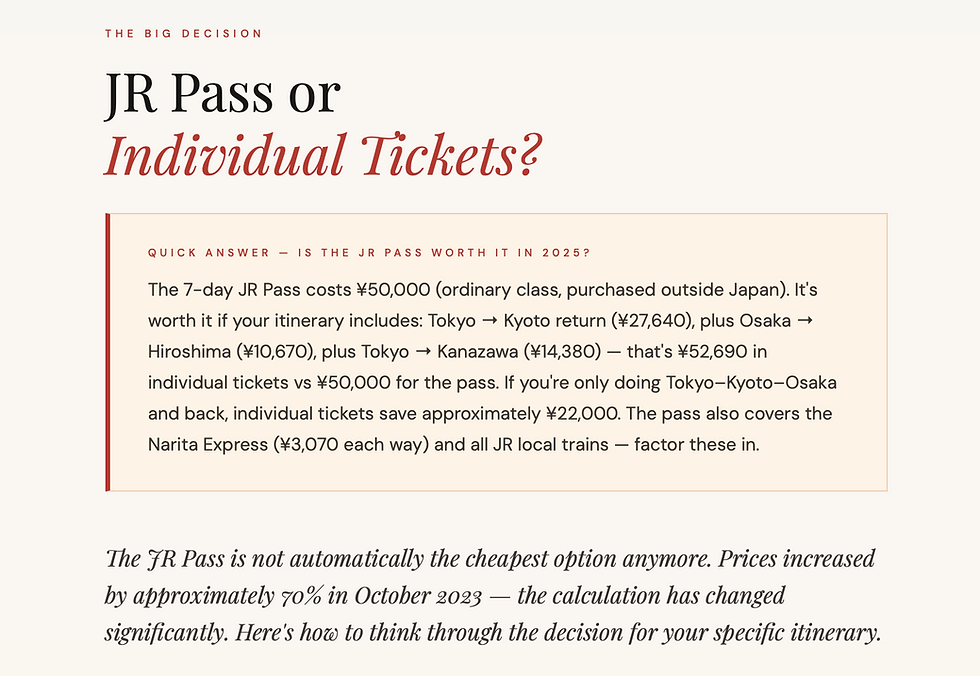
The 7-day JR Pass costs ¥50,000 (ordinary class, overseas price). It's worth it for multi-city itineraries. Tokyo to Kyoto return by Hikari costs approximately ¥27,640 in individual tickets. Add Tokyo–Hiroshima (¥18,800) and the pass has paid for itself. However, for a simple Tokyo–Kyoto–Osaka-and-back trip, individual tickets save approximately ¥22,000. The pass also covers the Narita Express (¥3,070 each way) a meaningful bonus for those flying into Narita.
What is the difference between Nozomi and Hikari Shinkansen?
Nozomi is the fastest service on the Tokaido/Sanyo line (Tokyo–Osaka in 2h 27m, fewer stops) but is NOT covered by the JR Pass an individual ticket is required. Hikari is the semi-fast service (Tokyo–Osaka in approximately 2h 52m, more stops) and IS fully covered by the JR Pass. The time difference between the two is 15–25 minutes on most routes. For JR Pass holders, the Hikari is always the better choice on the main corridor.
How do I book Shinkansen tickets in Japan?
Five options: (1) JR Pass holders reserve free seats at any station's Green Window (Midori-no-madoguchi) counter. (2) Smart EX app allows English-language booking for Tokaido/Sanyo routes from overseas. (3) JR East's online platform covers Tohoku and Hokuriku routes. (4) Automated ticket machines at major stations have English modes. (5) Third-party platforms like Klook and KKday sell passes and individual tickets with English customer service support.
Do I need to reserve a seat on the Shinkansen?
Reserved seats are strongly recommended for journeys over 90 minutes, and essential during peak periods (cherry blossom, Golden Week, Obon, koyo autumn) when unreserved cars fill completely and passengers stand the entire journey. Reserved seats cost ¥530–¥1,000 more than unreserved tickets. For JR Pass holders, seat reservations are completely free and unlimited there is no reason not to reserve every long-distance journey.
Which side of the Shinkansen should I sit to see Mount Fuji?
On the Tokaido Shinkansen travelling from Tokyo toward Osaka, Mount Fuji appears on the right side. Book seat D or E (window seats, right side). The view appears approximately 45 minutes after departure from Tokyo, between Odawara and Shin-Fuji stations, and lasts about 8 minutes. The clearest views are on winter mornings with minimal cloud cover. Use the Smart EX app to specify your seat preference when booking.
Can I use the JR Pass on the Nozomi?
No. The JR Pass does NOT cover Nozomi or Mizuho services on the Tokaido, Sanyo, and Kyushu Shinkansen lines. JR Pass holders must use Hikari (semi-fast) or Kodama (local) instead. Important distinction: on the Tohoku and Hokuriku lines, the fastest services (Hayabusa and Kagayaki) ARE covered by the JR Pass only Tokaido/Sanyo Nozomi and Mizuho are specifically excluded.
Where can I buy the JR Pass?
Buy the JR Pass before arriving in Japan from jrailpass.com (official), or authorised distributors and platforms like Klook and KKday. The overseas price is ¥50,000 (7-day ordinary) or ¥80,000 (14-day ordinary). Domestic sales inside Japan exist (since October 2023) but at significantly higher prices approximately ¥70,000 for the 7-day ordinary class. Purchase before travel.
Plan Your Japan Trip with Global Journeys
Planning Japan well is the difference between a trip that ticks boxes and one that stays with you for years. At Global Journeys, we design Japan itineraries that move at a considered pace combining the cultural depth of Kyoto, the energy of Tokyo, and the quiet moments
that most group tours skip entirely. Reach out to us on WhatsApp: +91 88791 70009
ALSO IN THE JAPAN SERIES
READ GUIDE → Ready to start planning? Explore our Japan travel experiences or browse all our curated destinations.


Comments